
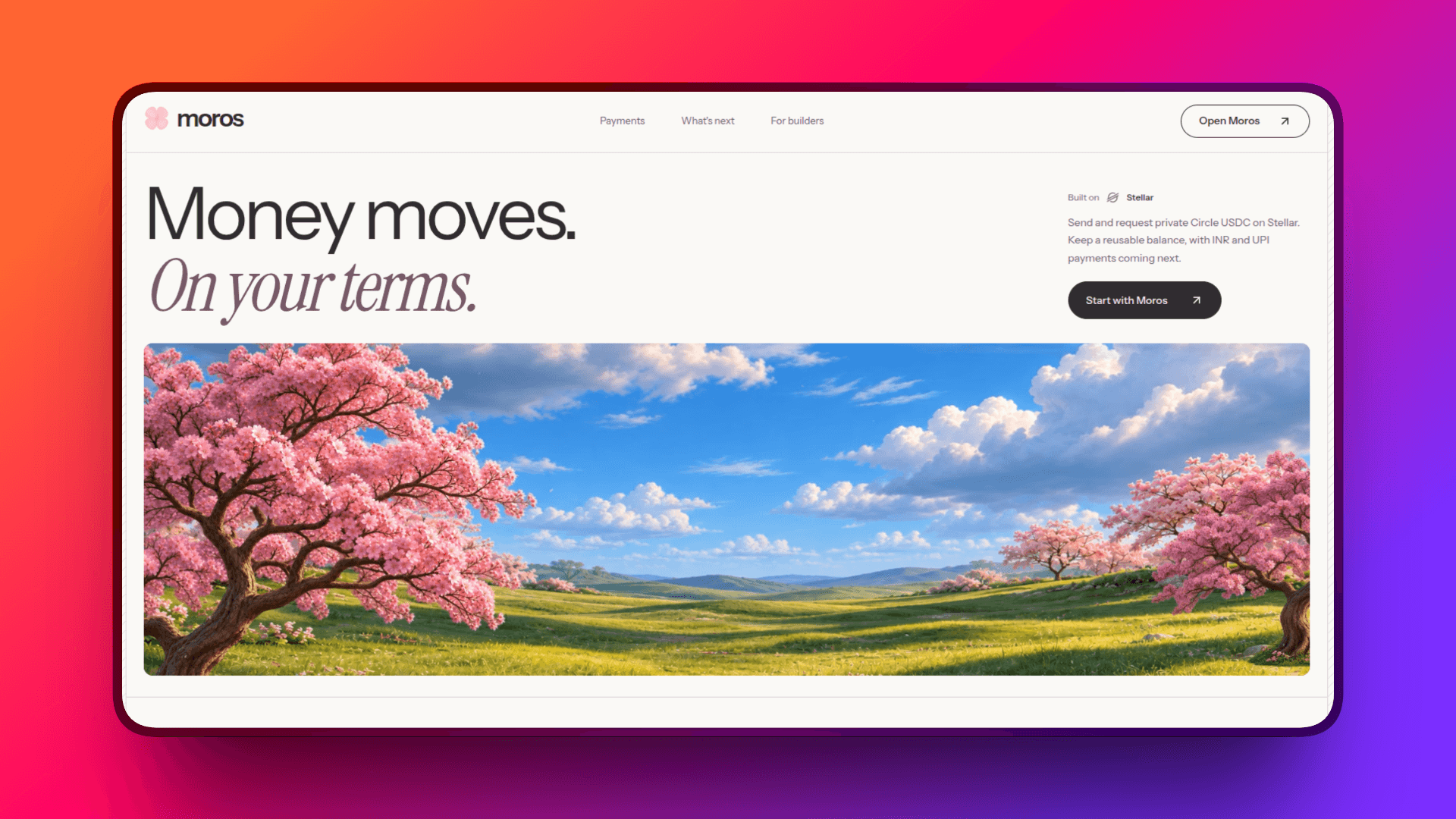
Moros - Payments and Financial Infrastructure on Stellar
Payments and financial infrastructure on Stellar Mainnet, settled in Circle USDC. Moros combines reusable private balances, signed requests, encrypted recovery, proof-bound settlement, and developer infrastructure.
Timeline
2026 - Present
Role
Protocol Engineer
Team
Hooman Digital
Status
CompletedTechnology Stack
Key Challenges
- Moving Circle USDC privately while preserving on-chain solvency and preventing double spends
- Making private balances and payment history recoverable across devices without exposing plaintext data
- Keeping payment identities independent from public Stellar accounts
- Binding seven payment circuits to production contracts and network-scoped deployment manifests
Key Learnings
- Designing commitment and nullifier flows for reusable private payments
- Building Rust and WebAssembly cryptography for browser-side identity, recovery, and proofs
- Operating proof relays, encrypted output indexing, and ciphertext-only synchronization
- Shipping Soroban contracts that settle real Circle USDC on Stellar Mainnet
Moros - Payments and Financial Infrastructure on Stellar
Overview
Moros is payments and financial infrastructure on Stellar Mainnet, settled in Circle USDC. It combines reusable private balances, commitment and nullifier notes, zero-knowledge verification, signed payment requests, encrypted recovery, payment services, and client libraries in one system.
The live Moros payment application lets a user create or restore a private identity, add Circle USDC, receive through a payment code, request a fixed or open amount, send private USDC, recover activity across devices, and withdraw to a Stellar account.
Moros won Stellar Build Station Pune 2026 and was selected for the Stellar Builder Residency Jaipur 2026. Its payment vault and verifier are deployed on Stellar Mainnet and use real Circle USDC. XLM is used only for Stellar fees and account reserves.
The Problem
Public blockchain payments expose a permanent financial graph. Wallets, counterparties, amounts, timing, and repeated activity can be connected across transfers. Creating another public wallet does not solve the underlying leak.
Moros separates private payment activity from public solvency. Stellar records the commitments, nullifiers, proofs, and public value movement required to protect funds without publishing internal note ownership, private counterparties, or reusable payment history as plaintext.
Product Capabilities
Reusable Private USDC
A user shields Circle USDC once and reuses the resulting private notes across payments. Received private USDC can be spent again without first withdrawing it to a public Stellar account.
Private Transfers
Payment codes identify a private recipient without embedding a public Stellar account. The sender creates encrypted recipient outputs and private change, then generates a proof that conserves value without revealing the private input notes.
Signed Payment Requests
Requests support fixed or open amounts and bind the recipient, asset, network, vault, amount policy, creation time, and expiry to a signature. The client verifies those fields locally before preparing a payment.
Encrypted Recovery
Recovery phrases restore private identity material. Padded encrypted archives preserve balances, contacts, requests, receipts, and payment activity across devices without giving the storage provider readable financial data.
Developer Infrastructure
The payment contracts, Rust cryptography core, WebAssembly bindings, client library, proof relay, encrypted output indexer, and network-scoped deployment records can support additional financial applications without rebuilding the privacy layer.
Expanding Payment Rails
Standard USDC transfers and optional partner-supported USDC-to-INR UPI merchant payments are planned extensions. They are not presented as completed capabilities in the current release. An Android client is also under development.
How a Private Payment Works
1. Create or Restore an Identity
The client derives network-scoped spending, viewing, encryption, request-signing, and recovery material locally. A Moros payment code contains the private recipient material needed to create an encrypted output.
2. Add Circle USDC
The user connects an existing Stellar wallet and authorizes a deposit into the Moros payment vault. The client creates encrypted outputs for the private identity and binds them to a zero-knowledge deposit proof.
3. Verify the Recipient
The sender pastes a payment code or opens a signed request. The client checks its checksum, network, vault, asset, signature, amount policy, and expiry before generating a proof.
4. Prove and Relay
The client selects one, two, or four private input notes, creates recipient and change outputs, and generates the matching Groth16 proof. The relay submits the proof-bound contract invocation without receiving the private witness.
5. Recover and Reuse
The recipient discovers encrypted vault outputs and decrypts matching notes locally. The received USDC remains reusable inside the private balance, while encrypted sync keeps recovery durable across devices.
6. Withdraw When Needed
The owner proves control of private input notes and directs Circle USDC to a valid Stellar account. Published nullifiers prevent those notes from being spent twice.
Zero-Knowledge Payment Architecture
Moros uses seven Circom Groth16 circuits over BN254:
| Circuit | Private inputs | Purpose |
| --------------- | -------------: | -------------------------------------------------------- |
| deposit | 0 | Convert public Circle USDC into private notes |
| transfer_one | 1 | Spend one private note into recipient and change outputs |
| transfer_two | 2 | Combine two private notes for a transfer |
| transfer_four | 4 | Combine up to four private notes for a transfer |
| withdraw_one | 1 | Withdraw from one private note |
| withdraw_two | 2 | Withdraw from two private notes |
| withdraw_four | 4 | Withdraw from up to four private notes |
Every circuit binds the action context, membership root, nullifiers, output commitments, encrypted output hashes, attachment hash, and public amount. Proof generation happens on the client, so the relay does not receive the private witness.
Mainnet Deployment
| Component | Stellar Mainnet contract |
| -------------------------- | ---------------------------------------------------------- |
| Payment vault | CCKD5AHU2JGUR7RWMI5CT3UVOOCPDTQYK43DI24GKRKKUWZ3N22UOAIR |
| Payment verifier | CB4L4FGBRY2D53MYETJH45OVFWCXRBJEHTW7B4W56XROQ26VSHQPSPR5 |
| Circle USDC asset contract | CCW67TSZV3SSS2HXMBQ5JFGCKJNXKZM7UQUWUZPUTHXSTZLEO7SJMI75 |
The vault and verifier are Moros deployments. Circle USDC is the existing settlement asset. Network-scoped deployment and proving manifests bind clients to the expected Stellar network, contracts, asset, circuit names, and artifacts.
Infrastructure
- A Soroban payment vault that holds Circle USDC and validates private note transitions
- A Groth16 verifier for the registered payment circuit shapes
- A Rust payment core with WebAssembly and native mobile bindings
- A payment API and relay for proof-bound contract submissions
- An indexer that discovers encrypted outputs without becoming the source of truth for note ownership
- Ciphertext-only synchronization for profiles, contacts, requests, receipts, and activity
- Network-scoped manifests that make mismatched networks, contracts, assets, or proof artifacts fail closed
Privacy Boundary
Public on Stellar
- The Stellar account and amount at a public deposit or withdrawal boundary
- Contract addresses, commitments, spent nullifiers, and proof verification
- Public value movement and aggregate vault accounting
Not Published as Plaintext
- Private note ownership and reusable private balances
- Internal payment counterparties and history
- Recipient private identity material
- Contacts, requests, receipts, and activity stored in encrypted recovery
Tech Stack
- Contracts: Rust, Soroban SDK, Stellar Asset Contracts, and SEP-41 token interfaces
- Proofs: Circom, Groth16, BN254, commitments, nullifiers, and encrypted outputs
- Client Core: Rust, WebAssembly, Baby Jubjub, Poseidon2, and canonical CBOR
- Web: Next.js, React, TypeScript, Stellar SDK, and Freighter
- Services: Node.js, Stellar SDK, proof relay, encrypted output indexing, and recovery services
- Data: Stellar RPC, Horizon, Supabase Postgres, and AES-256-GCM encrypted synchronization
- Production: Stellar Mainnet, Circle USDC, Vercel, and independently operated payment services
Challenges and Solutions
Private Payments Without Losing Solvency
The payment vault publishes commitments and nullifiers instead of a readable internal ledger. Groth16 proofs bind every state transition, while nullifiers prevent note replay and double spending.
Private Recipients Without Public Accounts
Moros payment codes carry the private recipient information required to encrypt an output. Signed requests additionally bind payment policy and expiry before the sender creates a proof.
Durable Recovery Without Plaintext Storage
The client encrypts private state before synchronization. Infrastructure can store and return padded ciphertext, but balance ownership, contacts, requests, and payment history are recovered only by the client.
Reusable Infrastructure Instead of a Single Flow
Contracts, proof shapes, cryptographic libraries, relay services, indexing, and recovery are separated into reusable components. New Moros payment experiences can build on the same verified foundation.
What I Learned
- How to design reusable payment infrastructure instead of a single isolated privacy feature
- How to connect seven proof circuits, browser cryptography, Soroban contracts, relays, indexing, and encrypted recovery
- How to make payment identities recoverable without tying them to a public Stellar account
- How to operate production Stellar contracts that settle real Circle USDC on Mainnet