
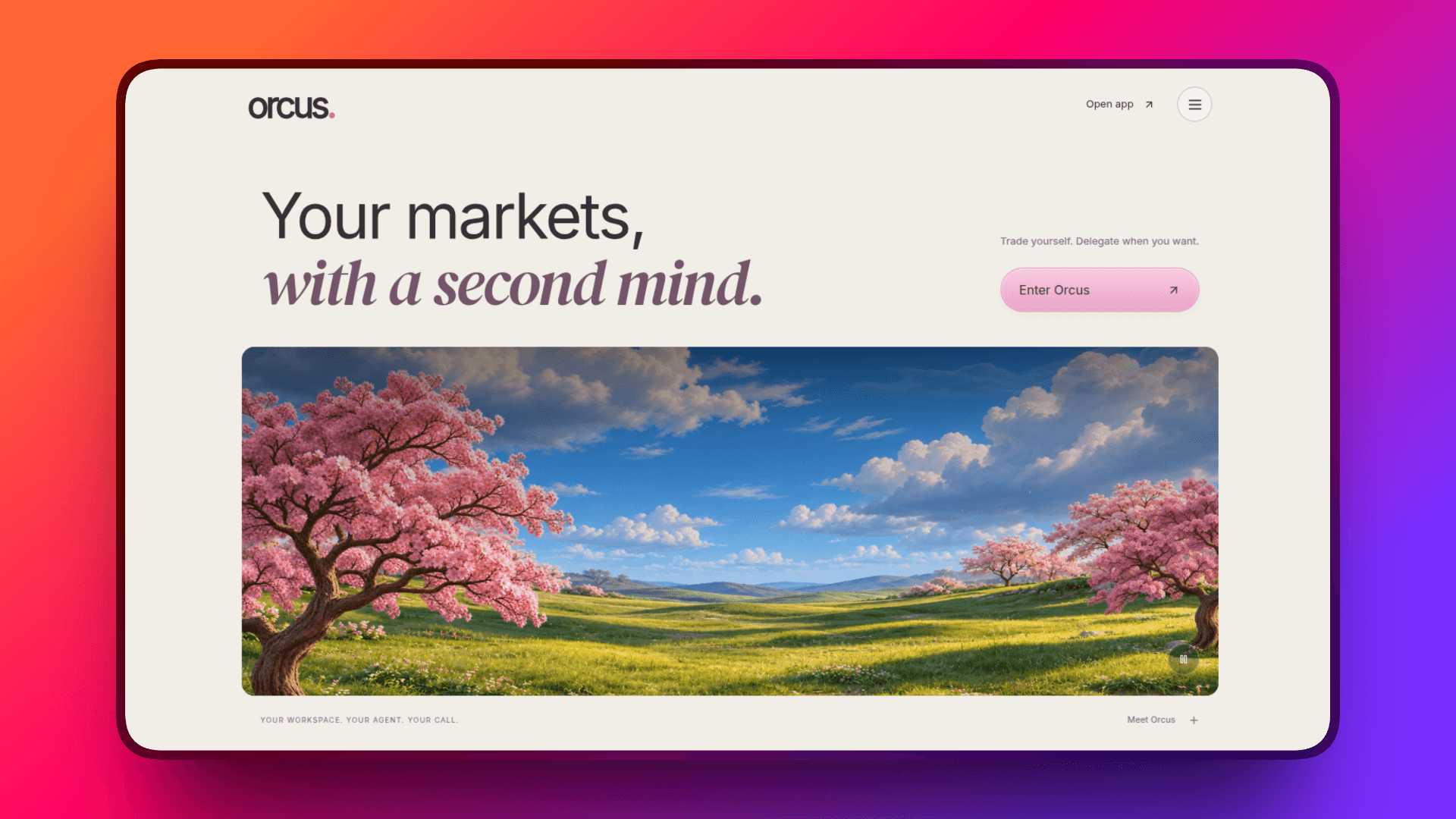
Orcus - Personal Trading Agent
A personal-agent trading platform where users and authorized agents work from the same trading accounts, permissions, positions, and execution history.
Timeline
2026 - Present
Role
Full Stack Blockchain Developer
Team
Hooman Digital
Status
In-progressTechnology Stack
Key Challenges
- Giving an agent bounded trading authority without asking users to share wallet private keys
- Keeping manual and autonomous execution synchronized across venue-specific account models
- Separating trading capital, gas, compute budgets, storage costs, and service credits
- Making scheduled automation durable without allowing retries to duplicate paid calls or trades
Key Learnings
- Designing owner-controlled delegation across smart accounts and native exchange agents
- Building bounded tool-calling agents with durable checkpoints and explicit approvals
- Coordinating conditional trading workflows through Chainlink CRE
- Encrypting agent memory before optional decentralized storage backups
Orcus - Personal Trading Agent
Overview
Orcus is a personal-agent trading platform where users and authorized agents manage the same supported trading accounts. Manual controls and agent capabilities share execution, permissions, position state, and activity history, so a user can delegate work without creating a disconnected agent portfolio. Users keep their owner wallets and never share a seed phrase or private key with Orcus.
The current testnet workspace brings together Uniswap spot trading, Hyperliquid perpetuals, and Ostium markets. A 0G-powered agent supports research, planning, and typed action proposals, while Chainlink CRE coordinates conditional workflow checks and durable automation.
Orcus received the 0G APAC Hackathon 2026 Excellence Award on June 12, worth approximately $4,000.
The Product Model
Most trading agents force users to choose between manual control and automation. They often create a separate portfolio, hide authorization boundaries, or treat a connected wallet as blanket permission. Orcus gives the owner and agent one shared workspace while keeping their authority separate.
- Connecting a wallet does not grant trading authority.
- Manual actions continue to use the owner path.
- Autonomous actions require an active, bounded grant for the selected venue.
- Owners can pause automation, revoke access, rotate agent credentials, or take over manually.
- Trading capital stays separate from compute, storage, and operating budgets.
Key Features
One Workspace for Owner and Agent
Positions, orders, balances, permissions, automations, and execution history live in the same routed workspace. The owner can trade directly, ask the agent to prepare an action, approve a proposed action, or activate a reviewed automation without losing visibility into the resulting account state.
Scoped Delegation
Each venue keeps its native account model. Uniswap uses a user-owned ERC-4337 smart account with bounded session permissions. Hyperliquid uses its native agent-wallet authorization against the owner's existing account. Ostium actions preserve their own account and delegation rules. Orcus adds per-trade risk checks and clearly separates application limits from restrictions enforced by the venue itself.
Agent Research and Planning
The agent uses LangGraph with a bounded tool set for market reads, portfolio inspection, indicators, research, and typed action proposals. 0G Compute powers inference, but signing remains outside the model. Approval-required proposals return to the owner path, while unattended actions must pass the current account grant and risk policy before execution.
Durable Memory
Per-user memory stores preferences, execution episodes, and checkpoints locally. Sensitive memory is encrypted before optional backups to 0G Storage. Request identifiers and durable checkpoints prevent a retry from silently repeating a potentially billable model call or trade.
Conditional Automation
Users can review and activate recurring trades, agent-planned strategies, and read-only price alerts. Chainlink CRE performs authenticated local workflow simulations with actual chain and HTTP observations. Results are consumed by a durable worker, persisted across restarts, and deduplicated before any notification or action.
Explicit Failure and Recovery States
Orcus records pending, rejected, unknown, and recoverable operations instead of replacing unavailable integrations with simulated success. Wallet transfers, service credits, compute expenses, storage writes, and venue actions each have separate recovery paths and idempotency controls.
Supported Trading Venues
Uniswap
The Uniswap path supports owner and delegated spot swaps through a user-owned Kernel smart account on Ethereum Sepolia. Session permissions constrain calls, expiry, and gas policy, while application-level checks enforce the reviewed trade limits.
Hyperliquid
The Hyperliquid integration shares the owner's testnet account state with an approved agent wallet. It supports market context, orders, cancellations, position management, protective orders, manual takeover, and explicit native agent revocation.
Ostium
The Ostium workspace adds global market exposure on Arbitrum Sepolia with venue balances, positions, orders, history, risk information, and bounded owner approvals. Venue-specific collateral and identities remain isolated from Uniswap and Hyperliquid.
Privacy and Execution Boundaries
Orcus protects agent context and stored memory, but it does not describe public on-chain trades as private. The current product focuses on controlled delegation, shared account state, durable automation, and transparent execution boundaries. Users can see which network, account, signer, allowance, and policy applies before an action proceeds.
Tech Stack
- Agent runtime: TypeScript, Node.js, LangGraph, typed tools, durable checkpoints, and SQLite memory.
- Frontend: Next.js and React with routed trading, activity, automation, funding, and settings workspaces.
- Reasoning and memory: 0G Compute for agent inference and optional encrypted backups on 0G Storage.
- Automation: Chainlink CRE workflow simulations consumed by a durable worker.
- Execution: Uniswap on Ethereum Sepolia, Hyperliquid testnet, and Ostium on Arbitrum Sepolia.
- Authorization: Owner wallets, ERC-4337 Kernel sessions, native venue agents, scoped permissions, expiry, revocation, and key rotation.
Challenges and Solutions
One State, Multiple Authorities
The owner and agent operate against the same supported account state, but every action records its initiator and passes through the correct authorization path. This prevents agent activity from becoming a second invisible portfolio.
Venue-Specific Permission Models
Orcus keeps a shared product model while preserving the underlying guarantees of each venue. It does not present application-enforced limits as native protocol restrictions, and disabling local automation is kept distinct from revoking on-chain or exchange authority.
Reliable Automation
Durable request IDs, checkpoints, worker state, and reconciliation logic make retries safe across restarts and uncertain provider responses. A missing receipt or unknown billing result blocks unsafe repetition until the original operation is resolved.
What I Learned
- How to design a trading agent around explicit owner authority instead of wallet custody.
- How to normalize manual and delegated actions across smart accounts and exchange-native agents.
- How to combine 0G inference and encrypted memory with Chainlink CRE automation.
- How to model failures, budgets, recovery, and idempotency as first-class product states.